|
|
Here is the music for the various dances of the Kabalkada. You can listen, or download these mp3 tunes below by right-clicking your mouse, and select "save as."
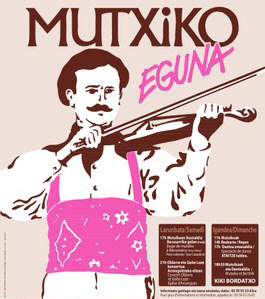
Related links: The jauziak, mutxikoak, or sauts basques are circular dances in which the participants, without making physical contact with one another and keeping the center of the circle as a reference point, execute certain steps or dance moves that vary according to each particular dance. Steps like the zote, dobla, and pika maintain the direction of the dance, while steps like the erdizka, ezker, and eskuin change its direction. Steps that maintain the dance's direction are always initiated with the foot toward the outside of the circle, and spins and changes of direction are always completed with the foot toward the inside of the circle. The best-known short jauziak are Hegi, Ostalarrak, and Marianak, and long are the Mutxikoak, Lapurtar Motxak, and Moneinak.
The jauziak have been danced to the accompaniment of a wide range of instrumental groupings, and they also have been sung. The use of one or another instrument has varied across eras, fashions, or, usually, the availability of musicians. Among the instruments that accompanied the jauziak (between the seventeenth and nineteenth centuries), Jean-Michel Giiilcher cites as one of the most regular the violin-ttunttuna (a three-holed flute) accompanied by a psaltery (or stringed drum) grouping. As with many other dances, the lone danbolindaria or ttunttuneroa (taborer) was also common, whether playing the txirula or the txistua (Basque three-holed pipes) and the ttunttun (psaltery) or the danbolina (tabor), sometimes also accompanied by a backup drummer. From the nineteenth century onward, the accordion began gammg ground, and it has now become one of the main instruments used to interpret the jauziak. Indeed, one of our main musical references is Befiat Irigoyen, "Galtxetaburu," (Monterey Park-California 1934-1990) an accordionist from Gamarte (Camarthe), Nafarroa Beherea. In addition to and accompanying the accordion are orchestras of wind and percussion instruments (clarinets, saxophones, trumpets, trombones, etc.) that have become a regular accompaniment for the jauziak in plaza dances and dance group performances.
Each of the jauziak fulfills its own choreographic structure -like a puzzle- through the combination of different steps, each with its own name and structure, and all known by the dantzariak (dancers). Each dance is organized and interpreted by the dantzariak knowing how to dance each of the steps, their order or structure, and their relationship to the musical discourse of each piece. The structures that define the distribution of steps and music have been passed down through various score collections compiled on the jauziak. Fortunately, we have been able to compare them with the actual dance masters who have taught them up until the present time. Therefore, sometimes, and depending on the source, we have found variants in the structure of the jauziak.
The ability of the dantzaria (dancer): who adorns the predetermined steps with particular flourishes within the limitations of mandated styles, especially in places like Luzaide where the dance has persisted. Traditionally, the names of the steps in the shortest dantza jauziak were not sung in the plaza. Only the most complex were called out by the dance master or a particular dancer. The execution of the entire dantza [auzia (jauzia dance) by memory was highly valued. Although today it is normal to mark or sing aloud the steps of the jauziak, in our opinion, memorizing the jauzia gives the dancer a holistic vision of the dance, helps the dancer to understand and better execute the linkages of the steps, and permits real enjoyment of the music.
For this edition, we have adopted Sagaseta's naming systems, which is also in current use in Luzaide and it coincides, for the most part, with that of Nafarroa Beherea-Lapurdi as well. The custom was that the dance master taught the steps in their homes, and then charged their students in kind. The students began with the shortest jauzia or jauzi buztanak (literally, the tailor end jauziak) in order to later memorize the intricate structures of the jauzi osoak (complete jauziak) favored in their localities. To execute some of the more complicated jauziak, the dance master -or skilled dantzariak arranged in different parts of the circle- marked aloud the steps to be made. However, a common system to memorize the jauziak melodies was for each danrzaria to hum the melody, together with the singing of the names of the steps at the starting point of each step. In this way, students learned the music and its choreographic structure at the same time.
The bralea of Zuberoa has been included in this version of the jauziak because it is the only example still found in the Basque Country of the branles (an old French group dance performed by couples either in a line or in a circle, characterized by stepping from side to side), which were probably the predecessors of today's jauziak and which share many characteristics (steps, disposition, circular dancing, erc.)."
There are variations, but here is how the Arnegi version is set up:
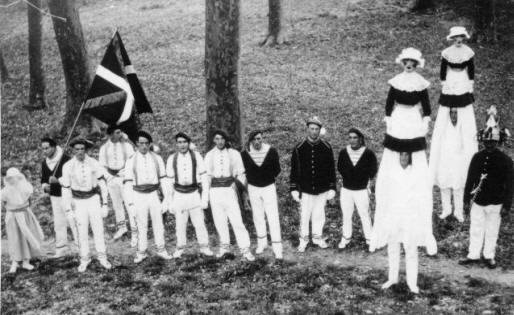
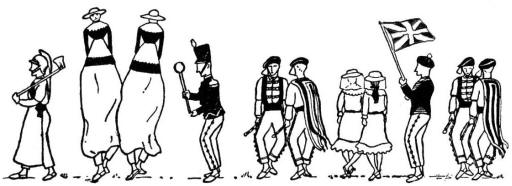
JANTZIAK: (Characters & costumes)
|
|||||||||||||||||||||||||