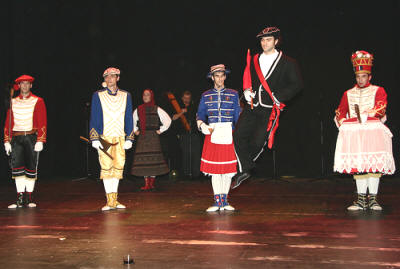
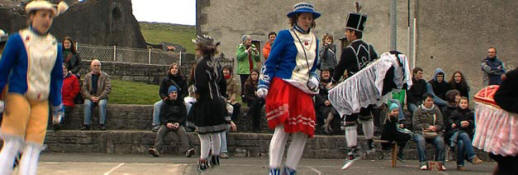
The Maskaradak of Zuberoa are some of the oldest--and most
difficult--of Basque dances. The plural 'k' ending
designates the two groups of the performance as the gorriak
("reds") and beltzak ("blacks"), though generally only
the five of the principle gorria performers are featured.
Potential Zuberoa workshop (Fall 2012 at the earliest)
__Proposed two person team coming here to work on
improving (not teaching from scratch because it simply
isn't efficient for the limited time they are here) what current groups are doing
with the Zuberoa Maskarada. Again it will span a
few days for concentrated work on these intricate steps.
__Hosting requirements: take care of room and board
cost of instructors while with you; their flights will
be covered by a Basque Government grant. It's
likely we will again use a regional rotation; not every
club who wants a workshop can have it in its hometown.
__Agreement vs. Clarity. Not all will agree as to
where and when these workshops will take place and for
whom; instead we'll go for clarity. These are
arguably the most difficult of Basque dances. It
is not realistic to expect to learn these quickly, thus
it would likely be a wasted effort to bring over a set
of European instructors to start from scratch because of
the time it takes to build the physical motor skills to
have a foundation. Thus the proposal is that these
workshops be geared to assist dancers & instructors that
have already been working on these.
The hope is to maximize their time with us to make
improvements and take our dancing to a higher level.
Ados? |
From the smallest of the seven Basque provinces, Zuberoa, comes
some of the more complicated and splendid Basque folk dances.
With the end of winter, it is traditional that some of the small
towns in Zuberoa organize the unique "Maskaradak" or Carnival
celebration. The dances are only a portion of the day-long
performance which includes music, song and dance. The five
principal dancers from the "maskarada" are the "txerrero," who
prepares the way for the others by sweeping the path with a
horse's tail; the "katusaina" or the cat-man character who snaps
a wooden apparatus that represents a cat's claws; the "kantiniersa"
or canteen carrier which is a recent addition from the
Napoleonic period in France; the "zamalzaina" or hobby-horse
character that represents a stallion; and the "entsenaria" or
standard-bearer. The dances are centuries old, and they are
believed to be an ancient pagan fertility rite.

A typical size group to
put on the entire Maskarada with the Reds & Blacks.

When possible, the
dances are played with the Zuberoa style of txistu called the "xirula"
and keeping the beat is the "ttun-ttuna"

The five principle "red"
characters are (L-R): Txerreroa, Gatuzaina, Zamalzaina, Kantiniersa
& Entsenaria
 Zuberoa
Though the smallest historical region, it has some very unique
folk traditions.


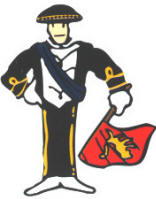
The following are moments from a Maskarada
Source:
https://www.xiberoa.pirenifoto.info/galerie-maskaradak.html

Bonetak

Barkoxen

Bazkaria: performers getting ready!

Herriko etxea

Frontoian

The whole ensemble

Pitxu

Bohemiak

Kanta!

Barrikadak Atzürükün

Hartza

Plazan

Anderea