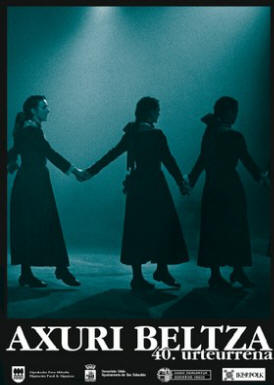
Though many think
it is much older, this dance was
choreographed by Juan Antonio Urbeltz back in 1969, based on the
research he conducted among women who dance when they were
younger.
Related link:
www.dantzariak.net/dantzaldizkaria/feb02_article.htm
This
article is reproduced here in case it is re/moved. It was
originally posted by
N. Azurmendi
in May 2009 at Diariovasco.com at
axuri-beltza-cumple-anos-20090505.html The
translation is via googletranslate
No one must be a seasoned Basque folklorist to recognize from
the first chords and lyrics of Beltza Axuri ("black sheep").
Often danced with more enthusiasm than skill, this is a dance
that is in the repertoire of many Basque dance groups, which is
danced in the streets and in its musical version, and again
performed by a number of Basque choirs. And Axuri Beltza
is now part of what they call the cultural . . .
If the antiquity of Axuri Beltza became the subject of betting,
the "smart money" would probably defend its ancestral,
traditional origins. "It is one of the few dance songs
that are preserved" or "some see this dance as a dance of
witches", say some of the descriptions for Axuri Beltza that can
be found on the Internet, highlighting the links of the dance in
question to the past, the more remote the better. But if
the winning bet of when this dance was created goes to the one
who wagered when the Beatles were about to dissolve and humans
were only a few months from setting foot on the moon.
Axuri Beltza has not come directly from the mists of time, but
is due to the work of folklorist Juan Antonio Urbeltz. It
was he who recreated and combined elements from different
sources, and with the dance group Argia debuted this dance on
May 4, 1969 at the Teatro Victoria Eugenia de San Sebastian.
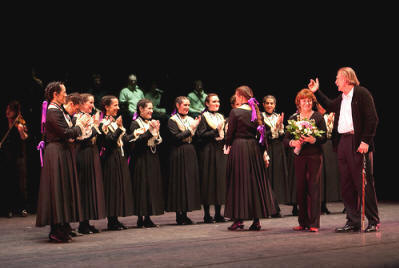 |
On the 40th anniversary
(1969-2009) of the creation of Axuri Beltza, a dance creation of
Juan Antonio Urbeltz and his wife Marian Arregi. |
Memory to the scene
Dance
was no stranger to the resurgence of the various expressions of
Basque culture. But
1936 [the Spanish Civil War] and its aftermath impacted
traditional Basque dance, disrupting the connection with the
period of extraordinary vitality that had preceded the Second
Republic. This same logic [of expressing Basqueness
through dance] re-emerged at the end of the 1950s and advanced
in the 1960s.
In the middle of that decade came Argia Dantza Taldea ("Argia
Basque Dance Group"), which since 1966 has been directed by the
anthropologist and folklorist Juan Antonio Urbeltz. In
those early years there was much needed field work in order to
"pick up dances that had been cut off from 1936 and only
reminded people of a certain age."
Urbeltz's group's repertoire, had been focusing on "social
dance, preferably Vizcaya and Soule, noted for its spectacular
nature and degree of difficulty and in its implementation of
excellence." He was struck, however, by the lack of dances
for women. Some were in groups and on stage, but their role is
generally limited to appear dressed in poxpoliña [the red skirts
with black stripes] and interpret a limited number of dances,
sometimes nothing more than adaptations of male dancing.
 |
The Lyrics of Axuri Beltza:
Axuri beltza
ona dun baina
xuria berriz hobea
dantzan ikasi nahi duen horrek
nere oinetara begira
Zertan ari haiz bakar
dantzatzen
agertzen gorputz erdia
su ilun horrek argitzen badin
ageriko haiz guzia |
In 1967, while researching and collecting the dances from
Otxagabia [Nafarroa] Juan Antonio and his then girl-friend and
soon to be wife and close collaborator, Marian Urbeltz Arregi,
were intrigued by a reference they
found on leaflets in the Narvarrese valleys of Roncal and
Salazar published by the Editorial Auñamendi.
It
was about a dance performed by the young girls of Jaurrieta [Nafarroa
town]. The publishers, and Jose Bernardo Estornés Lasa,
provided new clues indicating that the reference had been from
Azkue's Basque songbook collection, which contained the title of
Axuri beltza.
This provided the source of the melody and the lyrics, further
they knew that both made a dance, but they did not know the
steps. They tried again and went to visit to an old woman
from Jaurrieta. She told them that she remembered dancing
a dance accompanied by a harmonica.
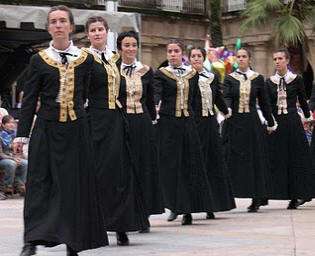
And so, putting the pieces together based on his deep knowledge
of traditional Basque dances, Urbeltz began to rebuild this
Basque dance. This recreation was based on information
provided by Azkue and scraps of memory that he had managed to
salvage, and the steps came from the mutil-dantzak of Baztán as
hinted at in the second part of the chorus.
The dance was executed to the sound of the accordion played by
Marian Arregi to reproduce the melody, and the xirula [Basque
flute] which provided the original pastoral touch. "It was the
first time for this combination," notes Urbeltz referring to the
musical portion characterized by a high profile women's voices.
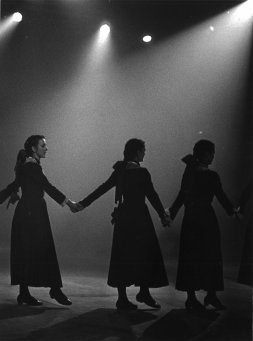
The simple and elegant black costumes paired with the entry
melody of Lekarotz Zikiro Beltza made for a staging surprising
on May 4, 1969, on the boards of the Victoria Eugenia when a
classic was born.
 Why
did some conclude this was a widow's dance? Why
did some conclude this was a widow's dance?
Excerpt from Dr. Lisa Corcostegui's explanation at
www.dantzariak.net
[How did a dance based on] young cow herders became
widowed in America. As I stated above, I believe there
are two main causes. One is the melancholy music of the
entrance and exit of the dance. It certainly is
somber. However, as soon as the actual dance begins the
mood lightens and offers no hint of mourning. The
lyrics which compare a black lamb with a white one, and
say that the one who wants to learn to dance must look
at the dancer's feet, also indicate no trace of
widowhood.
The second factor that I believe influenced the American
misinterpretation of the dance is the costume worn by
the dancers. While we are accustomed to wearing what we
please and expressing our individuality through
clothing, this was a foreign concept in many parts of
the Basque Country a hundred years ago. Dress was an
identity marker for the residents of particular valleys
or towns. Everyone of the same age or marital status
dressed the same way. The colors of trim on a garment
often indicated something specific about a person's
origin or status. Black was a dominant color for
clothing in the Salazar Valley. It did not inherently
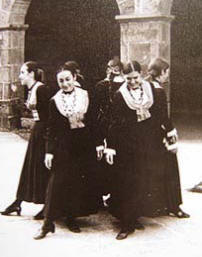
indicate mourning. The adolescent girls wore the black
skirt and black embellished jackets shown in the photos
above for special occasions and the first Sunday their
banns of marriage were announced at mass. When this
dance became popular among American dance groups, most
Basque-Americans were only familiar with the girl's
costume consisting of the red skirt, black vest, etc.
The regional costume of Eaurta stood in stark contrast
to the bright red of the traditional nationalist
costume. Lacking knowledge of the context in which the
dance developed, and searching for a meaning, dancers
here applied our modern cultural vocabulary in which
black equals mourning, and coupled with Urbeltz's solemn
prelude, formulated an explanation that made sense to
them. |
"By combining different elements to get a beautiful dance, among
other things, gave more prominence to the girls and helped us
achieve our goals: to bring simplicity to the scene," recalls
Juan Antonio Urbeltz. But the work-up which took nearly
two years was not as easy as it sounds, because of "how
complicated the recovery of a dance is. The creation has
to have its own pattern which, in turn, makes it fit into the
popular pattern, which has its own codes." So
reconstructing a dance is not only a matter of imagination, but
"all the pieces have to fit perfectly for a new dance based on
credible historical elements."
The premiere of Axuri Beltza was a "gala" attended by some of
the leading creators and promoters of the Basque cultural moment
of the time, including Jorge Oteiza, Remigio Mendiburu, many
members of the group Ez dok amairu. It "was one of the
first times that a traditional Basque dance show received more
than just mere mention in a newspaper."
Soon after they spent time teaching Beltza Axuri "to dozens of
groups." So great was the impact of a dance "that hit almost
immediately with a kind of collective memory" that in a few
years, managed to become ancient.
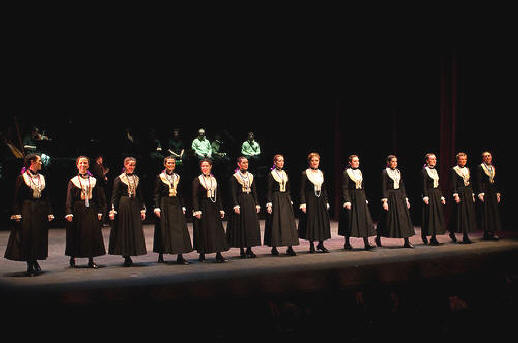
The final bow after the 40th
anniversary celebration performance of Axuri Beltza.