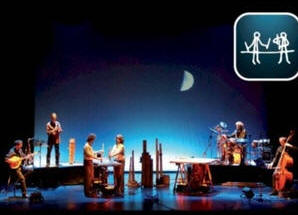
The Give and Take of Wood and Stone: Oreka Tx brings once
threatened Basque sounds and new global resonances to the U.S.
in September 2010 with their tour of the Basque
Txalaparta
Related links: Txalaparta Complete
tour dates
Oreka TX YouTube video clip
Previous concert video out
in the Washington D.C. area (site of NABO member)
https://takomapark.granicus.com
Sept 23 (Thur):
San Francisco
Basque Cultural Center
– 8PM
599
Railroad Avenue; So. San Francisco, CA
Sept 24 (Fri):
Chino
Basque House - 6PM
15181
Sierra Bonita; Chino, California
Sept 25 (Sat):
Globalquerque.com
1701 4th St. SW; Albuquerque, NM (new NABO member)
It can be a game, a friendly duel. It’s a dialogue, where
it’s just as important to listen modestly as to make a bold
statement. It can be made of wood, ice, stone.
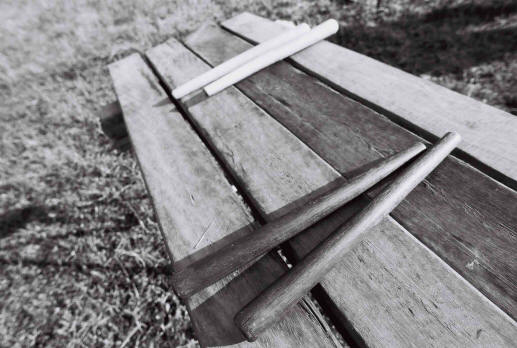
The answer to this riddle: a Basque percussion instrument, the
txalaparta, wooden planks laid over trestles and struck
with sticks held vertically. It resonates in the hands of
Oreka Tx, an ensemble whose album, Nömadak Tx (on World Village),
finds them exploring new voices and connections for this ancient
and once endangered instrument.
“It’s a very different understanding if you’re used to playing
your own instrument and mixing it with the band,” explains
Harkaitz Martinez de san Vincente, who along with Igor Otxoa
founded Oreka Tx. “You have to share the txalaparta with
another person. It’s the sharing of the rhythm that’s difficult,
and that’s the challenge.”
Oreka Tx—Martinez and fellow txalapartari Mikel Ugarte,
joined by several other musicians fluent in Basque and global
sounds—have taken their instrument, which they make themselves,
from precious folk symbol to cosmopolitan high art. The sound
recalls the marimba, but only in the way a piano resembles a
pipe organ. Its satisfying union of rhythmic and melodic colors
can be exploited in full, thanks to a duo of performers who are
constantly engaged in improvisatory give-and-takes and
passionate interwoven conversations, establishing and breaking
down each other’s beats.
Between France and Spain, the Basque people have strong ties to
the land and their language—though no links linguistically to
the surrounding peoples—and a past that extends back to the
beginnings of human settlement in Europe. The origins of the
txalaparta (pronounced CHOLL-uh-PART-uh) are shrouded
in the same sort of mystery as the Basques themselves: Its sound
has been connected to everything from galloping horses and
successful cider pressings to hill-to-hill communication.
Yet more recently, it was firmly linked to Basque identity, as a
distinctive, unmistakable, very audible instrument banned along
with the language under Franco. Condemned to silence, the
txalaparta nearly died out, leaving a mere four players (two
sets of brothers) by the 1960s. Thanks to a cultural revival
movement, however, the instrument gained a new lease on life,
and by the 1990s, was being taught regularly to interested
students.
The txalaparta’s near brush with extinction means
musicians can do almost anything, and be doing something
radical. “It’s a young instrument, and anything you do is new,”
Martinez muses. “You feel very close to the development, and by
building it yourself, you also get very close to the
instrument.”
For Martinez and Otxoa, this closeness combined with a love of
travel led to their recent exploration of nomadic culture and
txalaparta potential, Nömadak Tx, a project that
included a recording, documentary film, and now live multimedia
performances. Listeners get a glimpse of Oreka Tx’s epic journey
to the Sahara, the Arctic, the Subcontinent, and the steppes via
images and sounds interwoven with live musical performance.
The musicians of Oreka Tx went in search not only of nomads, but
of people who share some of the Basques’ difficult fate as
minorities without a recognized nation-state. They played with a
throatsinger from the reindeer-herding Tsaan of Northwestern
Mongolia, related to the Tuvans just across the border in
Russia. They worked with musicians in refugee camps in Algeria,
facing displacement and hardship after Morocco’s invasion. They
made music with Adivasi musicians in remote, overlooked corners
of India.
And wherever they went, they made a txalaparta from local
materials that defined the nomads’ lives. They carved planks of
ice with the Sami of Lapland. They struck stones in the Sahara,
to reflect the desert’s power.
These innovations not only helped them connect with musicians on
their travels, but changed the way they performed on the
txalaparta. “It was so nice to be working with different
materials like ice,” Martinez smiles. “The sound is very
different compared to wood. You can’t hit it hard, so you have
to play softer. We didn’t just make new songs on our journeys;
we made a new approach to playing.”
Regardless of the materials and style, the instrument itself,
while a meaningful part of Basque heritage, is also a powerful
symbol: Two players must interact respectfully and intently to
make any music at all. The dynamics of the instrument point to
new ways of relating between cultures.
“It’s a nice symbol: Two people have to play same instrument,
have to listen and respect other, to do one positive thing. The
music doesn’t belong to one or the other,” Martinez reflects.
“It can represent nicely the meeting point of different cultures
and people. And it gives us another way to express that we
Basques want to exist as part of this plural world, to give
another color to the world.”
To read more click
on
Txalaparta