|
|
|
|||||||
| A1.2: E.T.A. announces cease-fire | |||||||
|
|
|||||||
| Originally published 03-22-2006 by John M. Ysursa. Neither NABO or the Basque Government is responsible for the following content. For more information, or to get on our email list, send your name & email address to: info@nabasque.eus | |||||||
|
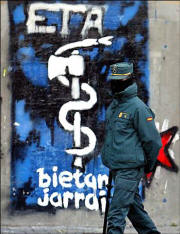
After four decades, is it realistic to hope that the conflict will really end? ETA had previously declared a cease fire, but this one is distinguished by the inclusion of the word "permanent." The previous full-scale cease-fire, in 1998, was described by ETA as "indefinite." It lasted only until early 2000, when the killing began again.
ETA's current declaration is not unconditional. The optimism generated from the "permanent" qualifier is tempered by ETA's further statement that called on France and Spain to respect a democratic decision of the Basques about their future with "no type of limitations." Thus Spain's deputy prime minister, Maria Teresa Fernandez de la Vega's guarded response that ETA's declaration is "a very good piece of news for all Spaniards. The government has the duty to be extremely prudent, you can't be cautious enough. ... It is our desire and our wish that this will be the beginning of the end," Reuters quoted her as saying. Sandra Dorada, a 29-year-old postal worker, was also cautiously optimistic: "It's amazing! I hope to God it's true," she said. "But they (ETA) have said this before and it wasn't true."
CNN reported that the cease-fire
announcement may come as a relief to several thousand ordinary Spaniards
-- teachers, journalists and local town councilors among them -- who
cannot leave home without armed bodyguards because of their outspoken
comments against ETA. There was no immediate indication that these
people would be giving up their bodyguards. Origins of ETA The initials ETA stand for “Euskadi ‘ta Askatasuna” [Freedom for the Basque Country]. The organization emerged during the years of Francisco Franco’s dictatorship in Spain. Franco’s forces prevailed in the Spanish Civil War of the 1930s, and the Basques of Spain found themselves on the wrong side of the decision. Franco’s vision of a totally unified Spain left no room for Basques that claimed to be distinctive. Franco systematically sought to rub out “Basqueness”: many Basques had their property seized and/or were jailed, he replaced the Basque Catholic clergy with Spanish imports and his regime outlawed the use of Euskara, the Basque language. Whenever Basques resisted, Franco’s regime responded with harsh repression. This situation in the Hegoalde ("South Side") of the Basque country in Spain significantly differed from the context in the Iparralde ("North side") French side of the Basque Country. While French authorities have never demonstrated a desire to promote “basqueness” in the Basque region there, they have never responded to its presence with the vehemence or intransigence of Franco’s regime. An anecdote related to me by a friend might perhaps demonstrate this contrast. Years ago while driving with a friend through the mountains of Gipuzkoa in the Hegoalde [“ETA Country!” is how he described it] a roadside house was pointed out. He told me how one night the Spanish Civil Guard came to the house to seize a suspected ETA member or sympathizer. The husband/father was drug out of his house and made to kneel outside where he was shot in the head in front of his wife and children. What if it had all been a mistake—what if they had the wrong man? My Basque friend continued: Where could the family go for help or justice? To the police? The police had just executed their husband and father. To the courts? The courts were military tribunals that suspended legal privileges and allowed testimony acquired under torture. It was explained to me that it is only in this context that the emergence of ETA occurred; it was a desperate attempt to somehow fight back against the power of the Spanish state. ETA began rather innocuously as only a student discussion group at the University of Deusto in Bilbao. It was originally called EKIN (“get busy”)Initially working with other Basque organizations pursuing a gradual approach, some grew impatient with the strategy of patience in resolving Basque problems. In 1959 a faction broke away and re-named itself ETA. In the early years, ETA action was deliberately non-violent, but the harsh reaction of the Spanish police to even minor items found ETA's response to be armed resistance. ETA's armed crusade phase began in 1968 and has since claimed almost 900 lives. Two-thirds of these victims were Spanish police officers, judges, politicians and of course innocent bystanders. In retaliation the Spanish authorities arrested over 10,000 suspected separatists; hundreds remain in prison at present for ETA related crimes. Then in the 1980s Spain’s Socialist rulers at the time hired gunmen to wage a counter-clandestine war. They in turn kidnapped and executed 27 ETA suspects—nine were later determined to be innocent victims. This polarizing conflict has left anger, hatred, revenge and confusion in its cyclical wake.
ETA members have always been few; most Basques never participated in this clandestine organization. But the armed crusade and rising death toll compelled all southern Basques to come to terms with it. During the Franco years, there were occasional demonstrations of support for ETA and significantly, almost no Basque protests against ETA. The overwhelming response from the Basques was a cold silence. Many of course could not accept the killing as a way to fight for Basque liberties, but the Franco regime’s repression effectively blocked alternative means of protest. Whether southern Basques liked it or not, ETA action served as a powerful check against Spanish authority. Again, my friend pointed out to me that no longer could a police officer decide to take the law into his own hands and summarily torture or execute a Basque; ETA would find that officer and make him pay for that. Basques did not entirely endorse ETA: violence was not universally acceptable, but it was nevertheless tolerated. Thus during the Franco years of repression ETA's attacks continued.
That was then, but in a post-Franco Spain things changed. Many hoped that with the passing of Franco in 1975 and the creation of a democratic Spain, ETA would desist and the conflict would end. These hopes were shattered when ETA actually increased its attacks. By 1980 the carnage reached a high with 88 killed, 81 wounded and seven kidnapped. As post-Franco Spain embarked on its democratic experiment which saw the creation of autonomous regions [Araba, Bizkaia & Gipuzkoa formed the region “Euskadi” and Nafarroa opted to form its own autonomous region] ETA continued to hit harder and harder. There was a logic to this: this increase followed from ETAs objective to achieve complete independence of the Basque Country. ETA militants apparently feared that the granting of degrees of self-government to the Basques would satisfy most Basque people and thus nullify the thrust for independence from Spain. ETA was thus engaged in the action-repression-action theory of conflict. Simply stated, the hope was to attack Spain in such a way as to produce a savage backlash on the part of Spanish authorities against all Basques. Thus when all the Basques felt Spanish wrath and oppression, they would realize their common destiny and together march toward independence.
The third change involved the undermining of the movement’s working principles. ETA across the years fluctuated between the use of Marxist ideas that promoted revolution against the established order and nationalism. With the collapse of communism, Marxist ideas became essentially defunct. Communism was now something of the past. That only left nationalism, and here there was no consensus. Basque nationalist aspirations remain divided. There is no broad based consensus on independence or what that means. ETA of course sought complete independence and the creation of a Basque nation-state. This objective contrasted sharply with the final change: the European surge toward unity. As borders between nations became increasingly blurred, the demand for the creation of a nation-state seemed curiously out-dated as Europe blazed a new trail into the future. But again, despite the hopes of those who hopefully predicted the disappearance of conflict in the early 1990s, ETA fought on.
ETA continued its armed fight confident of eventual success. But Spanish authorities refused the temptation of an all-out anti-Basque response (though the previous Spanish administration of President Aznar seemed tempted to bite), and the rising death toll only served to harden Spanish public opinion against granting terrorists anything. But you cannot lead if people do not follow. Apparently ETA clung to the notion that the general silence of Basque society denoted a tacit approval of their actions. But then some of ETA's bold moves altered this dynamic.
In the late 1990s ETA
gunmen kidnapped and executed Miguel Angel Blanco, a 29 year old Spanish
politician in the Basque Country. Whereas ETA militants could ignore
the previous declaration of condemning violence as mere political
posturing on the part of politicians, the Basque people's reaction to
the Blanco killing sent an unequivocal message. Basques in huge numbers
poured out onto the streets to join millions of others across Spain
shouting Nahiko da! "Enough!" This compelled ETA and its
supporters to reappraise the situation. Popular revulsion over the
killing launched a series of secret meetings, encouraged by the
political wing of the Irish Republican Army, Sinn Fein, to adopt a new
course. That led to ETA issuing its earlier cease-fire, but that dissipated and
the violence continued. Beginning of the end? ETA's current cease-fire raises more questions than answers. It is left to speculation as to why ETA said it would put down its arms this time around. In addition to the explanations above, some give credit to a concerted police crackdown in recent years in Spain and France with weakening the group. About 500 ETA prisoners are in Spanish jails, either convicted or awaiting trial, a government spokeswoman told CNN. Anti-terrorism sources say unofficially that another 140 to 150 ETA prisoners are being held in France. Others maintain that what finally marked the beginning of the end was the aftermath of the March 11, 2004 terror attacks in Madrid -- carried out by Islamic extremists -- that effectively stymied ETA. Public revulsion over terrorism now made deadly violence counterproductive for the Basque group. ETA has not killed anyone since 2003, and many of its recent attacks have been preceded by warning calls that gave police time to evacuate people before the bomb exploded. This declaration from ETA is cause for new-found optimism, but there are real challenges ahead if ETA violence is really go to disappear forever. Lehendakari Ibarretxe concluded his response to ETA's declaration with a general call to all Basques who live and work in the Basque country. "We have the right and the responsibility," he stated, "to go down this road together. Yes the work of political parties is crucial," he continued, "but the active participation of Basque society is essential. The hour has come that the weapons be definitively silenced." Ibarretxe concludes that it is time to reconcile Basque society, and that its future be decided in a context of peace and liberty.
Now only time will
tell. Maybe this time it will be different; maybe this time there will
be peace. Let us hope.
[SOURCES: “After the Fiesta: A Survey of Spain,” The Economist (April 25, 1992): 16-17; Richard Boudreaux, “Basque Separatists Borrow Irish Tactics,” The Los Angeles Times (October 23, 1998): A-1; Robert P. Clark, The Basque Insurgents: ETA, 1952-1980 (Madison, WI: Univ. of Wisconsin Press, 1984); SOURCES: Euskal Irrati-Telebista at https://www.eitb24.com/portal/eitb24/seccion_home/politics?idioma=en&cl=/eitb24/politica (March 2006); CNN at https://www.cnn.com/2006/WORLD/europe/03/22/eta.ceasefire/index.html
For more on this issue, visit these
links at CNN: |
|||||||


 ig news this week
is ETA's announcement that it plans to end its decades long struggle. In a videotape showing
ig news this week
is ETA's announcement that it plans to end its decades long struggle. In a videotape showing